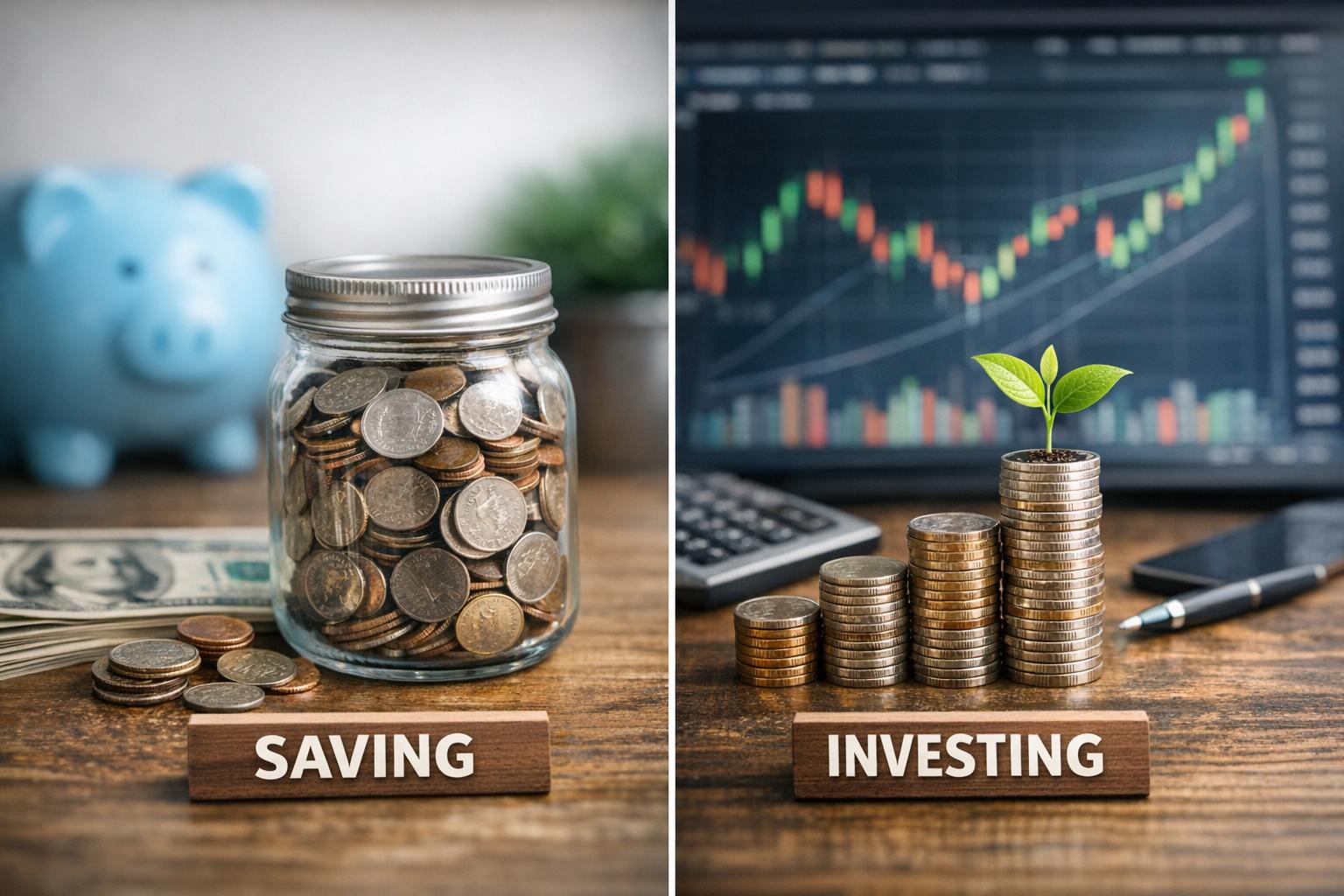
There is no single age, salary, or account balance that determines when a person should start investing. A suitable time is usually when basic financial needs are covered, expensive debt is under control, and the money can remain invested long enough to recover from normal market declines. For many people, this point arrives after they begin earning a regular income. Others may need to build cash savings or stabilise their finances before buying investments.
Starting early gives money more time to grow, but speed is not the only consideration. Investing rent money or relying on a credit card to cover emergencies is rarely a sound trade-off. The better question is not “Am I old enough to invest?” but “Can my finances support long-term investing without putting short-term obligations at risk?”
The answer depends on income, debt, savings, personal responsibilities, investment goals, and the period before the money will be used. Market forecasts should carry far less weight. Nobody knows with certainty whether shares will rise or fall next month, and delaying a long-term plan while waiting for perfect conditions can become a habit.
Why Starting Early Matters
The main benefit of starting early is time. Investment returns can remain in an account and generate further returns, a process known as compound growth. Compounding applies to both gains and income, provided that dividends, interest, and other distributions are reinvested rather than withdrawn.
Consider an investor who contributes $200 per month to a diversified portfolio earning an average annual return of 6% before fees and taxes. After 30 years, the account could be worth about $201,000. The investor would have deposited $72,000, while investment growth would account for the remaining value.
If the same person invested $200 per month for 20 years, the estimated balance would be about $92,000. They would have deposited $48,000. The ten-year difference affects the result because early deposits receive more time to compound.
| Monthly contribution | Investment period | Total contributed | Estimated value at 6% |
|---|---|---|---|
| $200 | 10 years | $24,000 | About $32,800 |
| $200 | 20 years | $48,000 | About $92,000 |
| $200 | 30 years | $72,000 | About $201,000 |
| $200 | 40 years | $96,000 | About $398,000 |
These figures are illustrations, not promises. Investment returns do not arrive at a steady rate each year. A portfolio may rise sharply, fall sharply, or remain flat for long periods. Taxes, account charges, fund fees, and inflation can also reduce the value available to the investor.
Even so, the example shows why a modest contribution started early can compete with a larger contribution started later. Someone who waits does not lose the ability to invest, but they may need to contribute more each month to reach the same target.
Time can also help an investor endure market declines. A person investing for retirement in 30 years may have room to wait through a recession or bear market. Someone buying a home next year does not have that flexibility. Time does not remove risk, though it can change how much short-term price movement a person can reasonably accept.
Saving and Investing Have Different Jobs
Saving and investing are both useful, but they are not substitutes for one another. Savings usually sit in bank accounts, term deposits, money market products, or other cash-based holdings. The aim is to preserve the money and keep it accessible. Investing involves accepting uncertainty in return for the possibility of higher growth or income.
Money for food, rent, insurance, loan payments, taxes, or an upcoming purchase generally belongs in savings. Exposing those funds to share market movements can turn an ordinary expense into a forced sale. If an investment falls by 25% shortly before the bill arrives, the investor must either accept the loss or find money elsewhere.
Investments are usually better suited to goals several years away. Retirement is the common example, but investing may also be used for future education expenses, a later home purchase, financial independence, or wealth intended for children.
The dividing line is not fixed. A flexible goal due in five years may support some investment risk, while a non-negotiable payment due at the same time may call for greater stability. The date, flexibility, and consequences of a loss all matter.
Inflation Changes the Calculation
Cash provides stability, but its purchasing power can decline. If inflation averages 3% a year, an item costing $10,000 today could cost more than $13,400 in ten years. A savings account paying less than the inflation rate may preserve the account balance while allowing its real value to fall.
This does not mean all cash should be invested. Emergency money serves an access and safety function, not a growth function. It does mean that holding every long-term asset in cash can create another form of risk. Investors need to weigh price volatility against the gradual loss of purchasing power.
Financial Conditions to Review Before Investing
A person does not need perfect finances before opening an investment account. Few households ever reach that standard. Still, a basic review can reduce the chance of selling investments at a poor time or taking on debt to meet ordinary costs.
Reliable Cash Flow
Regular income makes scheduled investing easier. An employee paid twice a month might arrange an automatic transfer after each payday. This removes some of the temptation to spend the money elsewhere and turns investing into a routine expense.
Freelancers, contractors, seasonal workers, and business owners can also invest, though a fixed monthly amount may not suit their cash flow. They might use a smaller base contribution and add more during strong months. A larger cash reserve can help cover periods with lower income.
Income does not need to be high. What matters is whether there is a repeatable surplus after essential costs, debt payments, taxes, and near-term expenses. A $50 contribution that can continue is more useful than a $1,000 contribution followed by a cash shortage.
Emergency Savings
An emergency fund covers costs that cannot reasonably wait, such as urgent medical care, a broken heating system, a car repair, or a period without work. It keeps a short-term problem from disrupting a long-term investment plan.
Many people use a target of three to six months of essential expenses. That range is only a reference point. A dual-income household with stable employment may be comfortable with less. A self-employed person, sole earner, or household with high medical costs may prefer more.
The fund should usually remain accessible and should not depend on selling shares during trading hours. It may be held in an insured bank account or another suitable cash product, subject to local rules and deposit protections.
Building an emergency fund does not always require stopping all retirement contributions. If an employer offers matching payments, an employee may contribute enough to receive the match while directing most spare cash to the emergency reserve. This approach balances a valuable employment benefit with the need for accessible money.
High-Interest Debt
High-interest debt often deserves priority over ordinary investing. Paying off a credit card charging 20% a year produces a predictable benefit: the borrower avoids future interest at that rate. A diversified investment portfolio may earn more or less than expected, and it can lose money.
Suppose a person has a $5,000 credit card balance at 20% and $5,000 available to invest or repay debt. Eliminating the balance could avoid roughly $1,000 of annual interest, depending on repayment timing and account terms. Earning the same return from investments would require a 20% gain before considering taxes and fees. That is not a sensible planning assumption.
Lower-rate debt requires a more measured comparison. A mortgage at 4%, an education loan with favourable terms, or tax-deductible borrowing may not need to be cleared before retirement investing begins. Liquidity, tax treatment, employer contributions, and personal comfort with debt can affect the choice.
A common order is to make all required payments, collect an available employer retirement match, build emergency savings, repay expensive consumer debt, and then raise investment contributions. The order may change according to local tax rules or household needs.
Insurance and Household Protection
Insurance can prevent a major loss from exhausting savings or forcing the sale of investments. Relevant cover may include health, disability, life, home, renters, vehicle, and business insurance. The right combination depends on local law, employment benefits, dependants, and the assets at risk.
A person supporting children may need life and disability cover before directing a large share of income into investments. Someone without dependants may have little need for life insurance but still face income risk after an illness or accident.
Insurance should address losses the household cannot comfortably absorb. It should not be treated as an investment unless the product is clearly understood, including its costs, surrender terms, commissions, and insurance benefits.
When Should Young Adults Start Investing?
Young adults can often begin after they earn regular income and have enough cash to meet ordinary expenses. The initial amount may be small. Starting with $25 or $50 per pay period can build the habit of paying a future goal before discretionary spending takes over.
Early adulthood often includes competing demands. Education debt, rental deposits, relocation costs, transport, professional training, and uncertain employment can consume much of a new worker’s income. Putting every spare dollar into the market may leave the person short of cash during a job change or move.
A balanced approach may direct money to several priorities at once. Part can go to emergency savings, part to debt repayment, and part to a retirement account. The percentages can change as income becomes steadier.
Employer Retirement Plans
An employer-sponsored plan may be a practical starting point because contributions can come directly from payroll. Some employers add matching contributions up to a stated percentage of pay. Failing to claim the full match means leaving part of the compensation package unused.
Vesting rules deserve attention. Employer contributions may become the employee’s property gradually, and leaving the job early could reduce the amount retained. Employees should also review plan fees and investment choices rather than assuming every workplace fund is inexpensive.
Age Does Not Set the Portfolio
Young investors are often told to hold an aggressive portfolio because they have decades before retirement. Time does support a greater capacity for market fluctuation, but age alone is not enough.
A 24-year-old saving for a home deposit in two years has a short horizon for that money. A 45-year-old investing for retirement at 70 may have a much longer horizon. Each goal needs its own time period and risk assessment.
Personal behaviour matters as well. A portfolio with a high share allocation is of little use if the investor sells after every sharp decline. A slightly more conservative mix that the person can maintain may produce a better real-life result.
Starting in Your Thirties, Forties, or Fifties
Beginning in midlife is not too late. An investor may still have 10, 20, or 30 years before using the money, and investments may remain in place throughout retirement. The plan may require higher contributions than it would have at age 22, but meaningful progress remains possible.
The starting point is a realistic calculation. The investor should estimate the amount needed, existing savings, expected pension or government benefits, planned retirement age, and likely annual contributions. Housing, healthcare, taxes, and support for family members should form part of the estimate.
People often have greater earning power in midlife, which can partly offset a later start. Debt may also decline as education loans, mortgages, or childcare costs fall. Increasing the contribution rate after a pay rise can direct part of the new income to long-term goals before spending expands to absorb it.
Avoid Compensating With Excessive Risk
A late start can tempt an investor to pursue concentrated shares, speculative assets, leveraged products, or trading strategies that promise very high returns. This approach may worsen the shortfall rather than close it.
Return targets do not control market outcomes. If a plan requires 15% annual growth to work, the problem may lie with the saving rate, retirement date, or spending target. Taking more risk does not make the required return more likely to arrive on schedule.
Useful adjustments may include saving more, working longer, reducing the target amount, paying off debt before retirement, or using a combination of those measures. The answer is often rather ordinary, which is not bad news. Boring plans are easier to repeat.
Catch-Up Contributions and Tax Rules
Some countries allow older workers to contribute more to tax-advantaged retirement accounts. Contribution limits, withdrawal conditions, tax deductions, and penalties differ by jurisdiction and can change over time.
Anyone using these accounts should check current official rules or consult a qualified tax professional. Tax benefits can improve a plan, but they do not compensate for unsuitable investments or high fees.
Starting Near Retirement
A person approaching retirement may still need investments because retirement can last for several decades. Moving every asset into cash at retirement may reduce short-term price movement, but it can expose the household to inflation and longevity risk.
The money needed during the first few years of retirement may call for more stability than funds intended for use 15 years later. Some retirees divide their assets by purpose, keeping near-term withdrawals in cash or high-quality fixed-income holdings while retaining growth assets for later spending.
This does not guarantee protection. Bonds can fall when interest rates rise, cash can lose purchasing power, and shares can remain below prior highs for years. The allocation should reflect spending needs, pension income, tax treatment, health costs, and the investor’s response to losses.
Sequence-of-Returns Risk
Retirees face a risk that workers do not experience in the same manner. A severe market decline during the early years of withdrawals can damage a portfolio because the retiree sells more units to fund spending while prices are low. Those units are no longer present to benefit from a later recovery.
This is called sequence-of-returns risk. Two retirees can earn the same average return over 20 years yet receive different results if their gains and losses occur in a different order.
Possible responses include holding a cash reserve, reducing withdrawals after weak market years, maintaining income from part-time work, delaying retirement, or choosing a more balanced asset mix. Advice may be helpful where tax, pensions, estate planning, and account withdrawal rules interact.
How Much Money Do You Need to Start Investing?
There is no universal minimum. Some brokers and investment platforms allow accounts to open with no initial deposit. Fractional shares and fund units may allow purchases with relatively small sums. Other providers set minimum deposits or require a set amount for recurring investments.
A small starting balance is not a problem by itself. The greater concern is whether account charges consume too much of each contribution. Paying a $10 transaction fee to invest $50 means losing 20% before the investment has moved. In that case, less frequent purchases, a lower-cost provider, or a no-transaction-fee fund may be more suitable.
Costs to Check Before Opening an Account
Broker advertising often focuses on commission-free trading, but commissions are only one cost. Investors should review account maintenance fees, fund management charges, bid-ask spreads, foreign exchange mark-ups, inactivity fees, transfer charges, withdrawal fees, and taxes.
A fund’s annual management charge may look small, yet it applies each year. A difference of half a percentage point can affect long-term results because the fee reduces the amount left to compound.
Investors should also find out how the broker handles uninvested cash, whether interest is paid, and whether securities may be lent to other market participants. These practices are not automatically harmful, but account holders should know the terms.
Account Ownership and Investor Protection
Before sending money, an investor should confirm that the broker is regulated in the relevant country. They should know which legal entity holds the account, where client assets are kept, and what investor compensation or deposit protection applies.
Protection schemes usually do not cover ordinary market losses. They may apply if a regulated firm fails and client assets are missing, subject to eligibility rules and compensation caps. Cash and securities can also receive different treatment.
Promises of guaranteed high returns, pressure to deposit immediately, payment requests through cryptocurrency, or difficulty identifying the regulated entity are warning signs. A professional-looking website is not proof that a broker is authorised.
Choosing Investments According to Time Horizon
The time horizon is the period before the investor expects to use the money. It helps determine whether the portfolio should favour stability, income, growth, or a mixture.
| Approximate horizon | Primary concern | Assets often considered |
|---|---|---|
| Less than 2 years | Access and capital preservation | Cash accounts, short-term deposits, suitable money market products |
| 2 to 5 years | Moderate stability with some income | Cash, short-duration bonds, conservative mixed funds |
| 5 to 10 years | Balance between growth and stability | Diversified combinations of shares and bonds |
| More than 10 years | Long-term growth and inflation risk | Broad share funds, bonds, and other suitable long-term assets |
This table offers broad reference points rather than personal recommendations. A flexible goal may permit more risk than a fixed obligation with the same date. Asset quality, fees, currency exposure, and the investor’s finances also matter.
Short-Term Goals
Money needed within one or two years generally should not depend on share market performance. A broad share index can fall by 30% or more, and recovery may not occur before the payment date.
Cash-based products can still carry inflation, currency, provider, or reinvestment risk. Term deposits may charge penalties for early access. Money market funds are investments rather than bank deposits in many jurisdictions. Product terms need careful reading.
Medium-Term Goals
A goal five to seven years away may support a mix of growth and defensive assets. The right balance depends on whether the spending date can move. Someone planning an optional holiday home purchase may wait after a market decline. A parent facing a fixed university payment may have less freedom.
As the date approaches, gradually moving part of the money into more stable holdings can reduce dependence on market prices at the point of withdrawal.
Long-Term Goals
Long horizons can support a greater allocation to shares because the investor has more time to wait through market declines. Shares have historically produced higher long-run returns than cash in many markets, but history does not guarantee a repeat.
Long-term investors still need discipline. A 20-year horizon does not help if the investor abandons the plan during year three. The portfolio should be uncomfortable enough to offer growth potential, but not so volatile that every market correction prompts a sale.
Risk Tolerance and Risk Capacity
Risk tolerance refers to a person’s comfort with uncertain returns and temporary losses. Risk capacity refers to the financial ability to absorb those losses. They may point in different directions.
An investor may enjoy risk and follow markets closely but need the money next year. That person has high tolerance but low capacity. Another person may have a secure salary, no debt, and 25 years before retirement but feel distressed by a 10% decline. That person may have high capacity but low tolerance.
Both should influence the portfolio. Ignoring capacity can put a goal at risk. Ignoring tolerance can lead to panic selling.
Think in Dollar Losses, Not Only Percentages
Risk questionnaires often ask how an investor would react to a percentage decline. Converting the percentage into money can produce a more realistic answer.
A 20% fall on a $5,000 account is $1,000. The same fall on a $250,000 account is $50,000. The percentage is identical, but the emotional and financial response may differ.
Investors can review past market declines to see how different asset mixes behaved. Historical events will not repeat in the same form, but they can show that losses are a normal part of investing rather than an unusual system failure.
Diversification and Straightforward Investment Choices
Diversification spreads money across companies, industries, countries, asset classes, and security types. It reduces dependence on the result of one holding. It cannot prevent losses when most markets decline at the same time.
Broad mutual funds and exchange-traded funds can offer diversification through one purchase. A global share fund may own hundreds or thousands of companies. A broad bond fund may hold government and corporate debt across several maturity dates.
Not every fund is broadly diversified. A technology fund, clean-energy fund, single-country fund, or cryptocurrency fund may hold several securities while remaining concentrated in one theme or risk source. The number of holdings alone does not settle the matter.
Index Funds and Actively Managed Funds
An index fund aims to track a stated market index before fees. An actively managed fund employs a manager or team to select holdings and attempt to meet its stated objective, which may include beating a benchmark.
Index funds often have lower management charges and predictable market exposure. Active funds may depart from their benchmarks and can outperform or underperform. Investors comparing the two should review cost, strategy, turnover, tax effects, manager tenure, and performance across both rising and falling markets.
Past returns should not be used as a promise. A fund that led its category last year may hold a concentrated position that later falls. Chasing recent winners often means buying after prices have already risen.
Simple Portfolios Can Be Easier to Maintain
A portfolio does not need a long list of funds to be diversified. Holding several funds that own many of the same large companies can create repetition rather than broader exposure.
A small number of broad funds may be easier to monitor, rebalance, and explain. If an investor cannot describe what a fund owns, why it is held, and what it costs, further research is warranted before purchase.
Should You Wait for Better Market Conditions?
Predicting the best day to invest is difficult. A market can appear expensive and continue rising. It can also fall after apparently good economic news. Professional investors with research teams regularly disagree about short-term direction.
Waiting for certainty creates its own risk because certainty usually arrives only after prices have moved. Investors who wait for a recovery may buy at higher prices, while those waiting for a crash may remain in cash for years.
Lump-Sum Investing
Lump-sum investing means placing available money into the chosen portfolio at once. This gives the funds immediate market exposure. Because markets have risen over many long periods, investing immediately has often outperformed gradual entry in historical studies. It also creates a greater short-term effect if the market falls soon after the purchase.
Investing in Stages
Investing in stages, often called cost averaging, divides the amount into scheduled purchases. An investor might place one-sixth of the money into the market each month for six months.
This approach can reduce regret after a sudden decline and make the plan easier to follow. It may produce a lower result if the market rises during the entry period because part of the money remains in cash.
Regular payroll investing is slightly different. The investor is not holding back an available lump sum; they are investing money as it is earned. For most workers, this is a normal contribution schedule rather than a market-timing strategy.
A Practical Process for Starting
Begin by stating what the money is for and when it may be needed. “Build wealth” is broad. “Invest for retirement at age 65” gives the plan a date and purpose. A person can then estimate the required contribution and choose an account with suitable tax and access rules.
Next, review monthly income, essential spending, debt, emergency reserves, insurance, and existing retirement benefits. The contribution should fit without creating repeated overdrafts or new credit card balances.
Compare regulated brokers and account providers. Review charges, available funds, minimum deposits, tax reporting, customer service, withdrawal processes, and asset custody. Low trading commissions should not distract from higher fund or currency costs.
Select an asset mix that fits the goal, time horizon, risk capacity, and tolerance. Broad, low-cost funds may be enough for many investors. Individual shares require more research and can expose the account to greater company risk.
Automate contributions where possible. Automation does not remove the need for review, but it reduces the number of monthly decisions. The contribution can increase after pay rises or debt repayment.
Review Without Constantly Reacting
Long-term accounts rarely need daily attention. Frequent checking can make ordinary price changes feel more consequential than they are. It can also encourage trading based on headlines.
A review once or twice a year may be adequate for many investors. A review is also sensible after a job change, marriage, divorce, birth, inheritance, major illness, home purchase, or change in the target date.
During the review, check whether the goal has changed, contributions remain affordable, fees are reasonable, and the asset allocation has moved away from its intended proportions. Rebalancing means restoring those proportions by directing new contributions or buying and selling holdings.
Common Reasons to Delay Investing
Postponing investments can be reasonable if the money is needed for essential expenses, employment is highly uncertain, expensive debt is growing, or there is no emergency reserve. A delay should have a purpose and a review date rather than continuing by default.
It may also be sensible to pause before investing in a product that is not clear. Pressure from a salesperson, social media promotion, or fear of missing out is not a reason to transfer money. The investor should know how returns are produced, what losses are possible, how money can be withdrawn, and what fees apply.
Temporary market fear is a weaker reason to delay a well-funded long-term plan. Markets always provide something to worry about: elections, inflation, interest rates, recessions, wars, company failures, or high valuations. Those concerns may affect returns, but they do not provide a dependable entry signal.
When the Right Time Has Arrived
A person is often ready to start investing when essential bills are covered, cash reserves are adequate for their circumstances, expensive debt is being addressed, and the contribution can remain invested for the planned period. They should also know that losses can occur and accept that no broker, fund, or strategy can guarantee market returns.
The starting amount can be modest. Consistency, cost control, diversification, and patience tend to matter more than making an impressive first deposit. An automatic contribution into a reasonably priced portfolio can form a sound base, provided the account and investments match the goal.
Starting early offers more time for compounding, but starting responsibly matters more than starting fast. Someone who begins later can still improve their position through higher contributions, realistic goals, careful account selection, and steady participation. The right time is not marked by a birthday or a market forecast. It arrives when the financial foundation and the investment period support the decision.