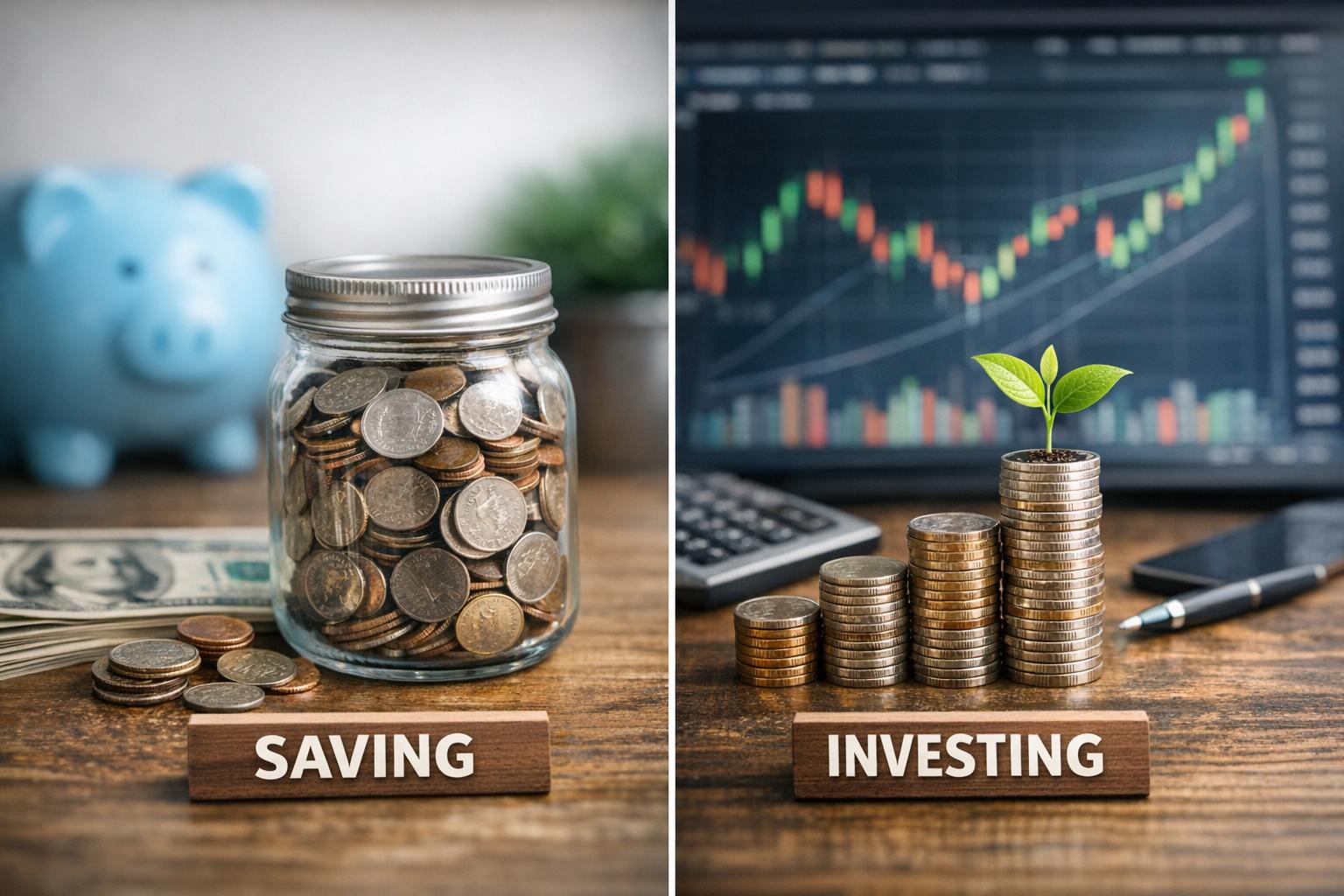
Saving and investing both involve setting money aside for future use, but they perform different jobs. Saving generally means placing money in an account or deposit product designed to preserve the original balance and provide ready access. Investing means buying assets that may rise in value or produce income, with no guarantee that the original amount will remain intact.
The main distinction lies in the relationship between risk, return, access, and time. Savings products tend to offer modest returns, stable balances, and straightforward withdrawals. Investments may produce higher returns over many years, but prices can rise and fall. An investor may receive less than the amount paid, particularly if an asset must be sold during a market decline.
Neither approach is automatically better. Money reserved for next month’s rent should not be treated like retirement money that will remain untouched for 25 years. Each amount has a purpose, and that purpose helps determine whether it belongs in savings, investments, or a combination of both.
What Is Saving?
Saving is the act of keeping part of current income for later use. The money may be held in a standard bank account, high-interest savings account, fixed-term deposit, certificate of deposit, or another low-risk deposit product. The usual aim is to protect the balance while retaining enough access for a planned purchase or an unexpected expense.
A bank normally pays interest on deposited funds. The interest rate may remain fixed for an agreed period or change as market rates and bank policies change. An account advertised with a high rate may also have conditions, such as a minimum deposit, a maximum interest-bearing balance, or restrictions on withdrawals.
Many countries operate deposit insurance or deposit guarantee programs. These programs may repay eligible customers if a covered bank fails, up to a stated amount. Coverage rules vary by country, institution, account ownership, and currency. A depositor should confirm whether an account qualifies rather than assuming every cash product carries government backing.
Saving is commonly associated with goals due within a few months or years. Typical uses include:
- Building an emergency reserve
- Paying annual insurance premiums or taxes
- Funding travel, education fees, or home repairs
- Preparing for a vehicle purchase or property deposit
- Holding money that will soon be used for living costs
The defining feature is not the name on the account. It is the expectation that the balance should remain dependable and available. A savings product that imposes a long lock-up period may not suit emergency cash, even if its interest rate looks attractive.
What Is Investing?
Investing involves committing money to an asset with the expectation of earning income, receiving capital growth, or both. Common assets include company shares, government and corporate bonds, mutual funds, exchange-traded funds, property, and retirement funds.
An investment return may come from several sources. Shares can pay dividends, bonds can pay interest, and property can produce rent. An asset may also become more valuable, allowing the owner to sell it for more than the purchase price. Of course, the reverse can happen. Income may fall, market prices may decline, or an issuer may fail to meet its obligations.
Investment values respond to company earnings, interest rates, inflation, credit conditions, economic activity, government policy, and investor expectations. Some assets move sharply from one day to the next. Others change slowly but may take months to sell. Price stability and ease of sale are separate matters.
Investing generally suits goals with a longer time frame. Retirement, future education costs, and wealth accumulation often sit in this category. More time does not guarantee a profit, though it can give a portfolio more opportunity to recover from short-term declines.
The choice to invest should depend on financial capacity rather than enthusiasm about recent returns. An asset that rose rapidly last year can still fall next year. Markets have a habit of charging tuition fees to anyone who assumes otherwise.
How Saving and Investing Differ
| Factor | Saving | Investing |
|---|---|---|
| Primary purpose | Preserve money for near-term use | Pursue income or growth over time |
| Risk to principal | Usually low in eligible deposit accounts | Varies from moderate to very high |
| Expected return | Usually modest and interest-based | Potentially higher, but uncertain |
| Access | Often immediate or available after a short notice period | Depends on the asset and market conditions |
| Typical time frame | Months to a few years | Usually five years or longer |
| Value fluctuations | Balance normally remains stable | Market value may change frequently |
| Inflation exposure | Interest may fall below inflation | Some assets may outpace inflation over long periods |
Risk to the Original Amount
A conventional savings account usually displays a stable cash balance. The account does not lose 10% because share markets had a bad week. That stability makes savings useful for money that must be available at face value.
Savings still carry risk. A bank can fail, although deposit protection may cover eligible balances. A saver may also lose purchasing power if inflation exceeds the interest rate. Foreign-currency deposits introduce exchange-rate risk, and fixed-term accounts may charge a penalty for early withdrawal.
Investments carry market and asset-related risks. A company can report poor earnings, a bond issuer can miss payments, or a property can lose tenants and require costly repairs. Funds that hold many securities spread exposure across holdings, but diversification cannot prevent every loss.
Risk also varies within each asset category. Shares in an established profitable company do not behave exactly like shares in a small unprofitable business. A short-term government bond differs from lower-quality corporate debt. Calling both of them “investments” says little about how much their prices may move.
Expected Return
Savings returns usually come from interest. If an account pays a fixed rate, the depositor can estimate the amount due at the end of the term. Variable-rate accounts are less predictable because the bank may raise or reduce the rate.
Investment returns are uncertain. A portfolio can produce dividends, interest, rent, and capital gains, but none should be treated as a promise unless a valid contractual guarantee applies. Even contractual payments carry the risk that the issuer will not pay.
Higher expected returns normally require accepting more uncertainty. This does not mean every risky asset will pay well. Some risky assets simply lose money. The principle means investors generally demand greater potential compensation before accepting greater chances of loss.
Liquidity and Access
Liquidity describes how easily an asset can be converted into cash without accepting a large price reduction. An instant-access bank account has high liquidity because the account holder can usually transfer or withdraw funds promptly.
Publicly traded shares and exchange-traded funds can often be sold during market hours. Settlement may still take one or more business days, and the market price may be below the investor’s purchase price. Access to a market does not guarantee access at a favorable valuation.
Property is less liquid. A sale can require valuation, marketing, negotiations, legal work, and financing approval from a buyer. Private company interests can be even harder to sell because there may be no active market.
Liquidity matters most when a payment deadline cannot move. A person who needs tuition money on a fixed date may not have time to wait for property or private assets to sell.
Time Horizon
The time horizon is the period before money will be needed. A shorter horizon leaves less time to recover from investment losses. Money needed within one or two years is commonly held in cash deposits or other low-volatility products.
A horizon of five years or more may allow room for investment risk, though the suitable approach depends on the goal. A five-year horizon for a compulsory house payment may call for more caution than a flexible goal that can be postponed.
The time horizon also shortens as the withdrawal date approaches. Someone investing for retirement in 20 years has a different position from someone planning to retire next year. Many investors gradually move part of a portfolio into lower-volatility assets as spending dates draw closer.
Purpose of the Money
Money should be assigned a job before a product is selected. A known tax bill, emergency reserve, and retirement account serve very different purposes. Placing all three in the same account may make management harder and encourage poor decisions.
Separate accounts can help. One account may hold emergency cash, another may cover annual bills, and an investment account may fund retirement. The labels are simple, but they reduce the temptation to use long-term assets for routine spending.
Why Emergency Funds Usually Belong in Savings
An emergency fund covers unplanned but necessary expenses. Medical costs, urgent repairs, temporary unemployment, essential travel, or a failed household appliance can all create a need for cash at short notice.
Because the timing is unknown, emergency money normally belongs in an accessible account with a stable balance. The return is secondary. The account’s main job is to be there on a bad Tuesday afternoon, not to win a performance contest.
The amount to hold depends on household expenses, income reliability, insurance, debt payments, family responsibilities, and access to other funds. A household with one irregular income may need a larger reserve than a household with two stable salaries. Self-employed workers may also prefer a broader cushion because revenue can vary by month.
Some people use a target of three to six months of necessary expenses. This is a reference point, not a universal rule. A smaller starting target can still be useful. Building one month of expenses, then adding to it gradually, is often more practical than waiting until a large target can be funded at once.
Keeping emergency money in shares creates a timing mismatch. If employment income stops during a market decline, the account holder may have to sell after prices have fallen. The temporary decline then becomes a realised loss.
When Saving Is Usually the Better Fit
Saving tends to fit goals that are near, fixed in amount, or dependent on capital preservation. If losing part of the money would prevent the planned payment, market exposure may be inappropriate.
Expenses Due Soon
Rent, tax payments, school fees, insurance premiums, and planned repairs usually require cash on a known date. The benefit of earning a possible higher return rarely justifies risking a shortfall before the bill arrives.
Even a broadly diversified share fund can fall sharply within a year. Historical recovery patterns provide no certainty about the date of the next recovery. A payment deadline is not likely to wait for a market rebound.
Known Purchases
Money for a vehicle, wedding, relocation, or property deposit may remain in savings if the purchase is expected within the next few years. Fixed-term deposits can work when the withdrawal date is known, though maturity dates should be matched to the planned purchase.
A saver may divide the amount across accounts with different maturity dates. This method can provide access at intervals while earning fixed rates on money not immediately required. Early-withdrawal rules should be reviewed before committing funds.
Low Capacity for Loss
Someone may be willing to take investment risk but lack the financial room to absorb a decline. If losing 15% would cause missed payments or new borrowing, the money probably should not be exposed to assets that can fall by that amount.
This distinction matters because willingness and capacity are not the same. Confidence during rising markets does not pay a bill after prices fall.
Money Awaiting a Decision
Cash may remain in savings while a person reviews investment choices, compares fees, or clarifies future goals. There is no need to rush into an unfamiliar asset. A modest interest return is often preferable to making a poorly researched purchase under pressure.
When Investing May Be the Better Fit
Investing is generally considered for money that will not be required for several years and can remain invested during market declines. The purpose is usually to pursue returns above cash interest and inflation.
Retirement Planning
Retirement may be decades away for a younger worker. Holding every contribution in cash for that entire period can allow inflation to erode purchasing power. A diversified portfolio may offer stronger growth potential, although returns will vary from year to year.
Retirement investing also benefits from regular contributions. Contributions made after a market decline buy assets at lower prices, assuming the investor continues the plan. This does not guarantee a good result, but it reduces reliance on making one large purchase at the right moment.
Long-Term Education Costs
Parents or guardians saving for education many years ahead may use investments for part of the goal. As the payment date approaches, moving money gradually into cash or lower-volatility assets can reduce the chance that a late market fall disrupts the plan.
Building Future Income
Investors may buy dividend-paying shares, bonds, or property to generate income. Income levels can change, however. Companies can reduce dividends, bond issuers can default, and rental property can remain vacant. A high advertised yield may reflect high risk rather than a bargain.
Preserving Purchasing Power
Cash provides nominal stability, but inflation can reduce what it buys. Investments such as shares and property have, during some long periods, produced returns above inflation. Results vary by market, entry price, fees, tax, and holding period.
Investing does not remove inflation risk. Some assets can trail inflation for years. The aim is to give money a reasonable chance of maintaining or increasing its purchasing power, not to promise that it will do so.
Common Savings Products
Instant-Access Savings Accounts
An instant-access account allows deposits and withdrawals with few restrictions. It is often used for emergency reserves and near-term spending. The rate may be variable, so interest income can change even if the balance remains the same.
Account holders should check minimum balances, transfer times, monthly fees, and withdrawal rules. “Instant” may still mean the next business day if funds are transferred between institutions.
Notice Accounts
A notice account requires the saver to request a withdrawal in advance. Notice periods may range from several days to several months. In return, the bank may offer a higher interest rate than an unrestricted account.
These accounts can suit planned spending but are less practical for emergencies. Withdrawing without proper notice may lead to a fee or loss of interest.
Fixed-Term Deposits
A fixed-term deposit holds money for an agreed period at a stated rate. Terms may run from a few months to several years. The saver gains rate certainty but gives up some access.
Before opening the deposit, the saver should check whether early withdrawal is allowed, what penalty applies, and whether interest is paid monthly, annually, or at maturity. Automatic renewal terms also deserve attention because the money may roll into a new term unless instructions are provided.
Money Market Deposit Accounts
Money market deposit accounts are bank products that may combine interest payments with restricted transaction access. They should not be confused with money market mutual funds.
A money market mutual fund invests in short-term debt securities. It is an investment rather than a standard bank deposit and may fall outside deposit insurance rules. Similar names do not mean identical protections.
Common Investment Types
Shares
A share represents ownership in a company. Shareholders may receive dividends and may benefit if the company becomes more valuable. They also bear the risk of falling profits, poor management, competition, debt problems, or business failure.
Individual shares can move sharply after earnings reports or company announcements. Holding shares across many companies and industries can reduce dependence on one business, though broad markets can still decline together.
Bonds
A bond is a debt security issued by a government, company, or other organisation. The issuer normally agrees to make interest payments and return the principal at maturity.
Bonds face credit risk, which is the chance that the issuer will miss payments. They also face interest-rate risk. When current market rates rise, older bonds paying lower rates often fall in price. Longer-maturity bonds tend to react more strongly to rate changes.
A bond held until maturity may return its stated principal if the issuer pays as promised. A bond fund has no single maturity date and its market value can continue to change as it buys and sells holdings.
Mutual Funds
A mutual fund pools money from many investors and buys a collection of securities. Some funds track a market index, while others employ a manager to select holdings.
Funds can provide broad exposure with one purchase. Costs vary, and higher fees do not assure better performance. Investors should review the fund’s objective, holdings, risk level, dealing schedule, and annual expenses.
Exchange-Traded Funds
An exchange-traded fund, or ETF, also holds a collection of assets but trades on an exchange like a share. Its price changes during market hours, and investors may pay brokerage costs or face a spread between buying and selling prices.
ETFs range from broad market funds to narrow sector, commodity, leveraged, or inverse products. The ETF structure alone does not make a product low risk. What the fund owns matters far more than the label.
Property
Property may provide rent and capital appreciation. It also brings maintenance, taxes, insurance, legal costs, management duties, and possible vacancy periods. Borrowing can magnify gains, but it also magnifies losses and creates mandatory interest payments.
Direct property ownership is concentrated because a large amount of money may sit in one building and one location. Property funds can spread exposure across more holdings, but they carry management fees and may restrict withdrawals during stressed market conditions.
Retirement Accounts
Retirement accounts may offer tax deductions, tax-deferred growth, employer contributions, or favorable treatment at withdrawal. Rules differ by jurisdiction and account type.
The account itself is not always the investment. It may act as a tax wrapper that holds cash, funds, shares, or bonds. An account can have attractive tax treatment and still contain unsuitable assets, so both layers need review.
Inflation and Real Returns
Inflation is the rate at which prices rise across the economy. If inflation is 3% a year, goods and services that cost 100 today would cost about 103 a year later, assuming the measured rate matches personal spending patterns.
A savings account paying 2% increases the numerical balance, but purchasing power falls if inflation runs at 3%. The approximate real return is negative 1% before tax. Personal inflation may differ because households do not buy the same mix of food, housing, transport, and services.
Investors should compare returns after inflation, fees, and tax. An investment earning 7% may sound strong, but a 2% fee, 1% tax cost, and 3% inflation rate leave a much smaller real gain.
Cash still has value even when its real return is negative. It provides stability and access. The mistake is expecting one product to perform every financial job at once.
Compound Growth and Regular Contributions
Compounding occurs when returns remain in an account and begin producing returns of their own. In a savings account, interest is added to the balance and future interest is calculated on the higher amount. In an investment account, dividends or fund distributions may be reinvested to purchase more assets.
Suppose 10,000 earns 5% a year and all returns remain invested. After one year, the balance would be 10,500. In the next year, the 5% return would apply to 10,500 rather than the original 10,000. If that rate continued, the balance would grow to about 16,289 after ten years before tax and fees.
Real investment returns do not arrive in a smooth line. A portfolio may gain 12% one year, lose 8% the next, and produce a smaller gain after that. The order of returns matters, particularly when withdrawals begin.
Regular contributions can matter as much as the rate of return. Someone who invests a manageable amount each month builds the account without relying on a single large deposit. Automation can help maintain the habit, provided contributions do not leave too little cash for routine expenses.
Risk Tolerance and Capacity for Loss
Risk tolerance refers to a person’s comfort with changing values and possible losses. One investor may accept a 20% decline without changing course. Another may lose sleep after a 5% fall and sell at the worst possible time.
Questionnaires can estimate risk tolerance, but actual behaviour during a decline often provides a more honest answer. People tend to feel bold after markets have risen for several years. Their view may change once the account balance starts dropping.
Capacity for loss refers to the financial ability to absorb a decline. Income stability, debt, dependants, insurance, time horizon, and near-term spending needs all affect capacity.
A person can have high tolerance but low capacity. An enthusiastic investor who needs the money for a house purchase next year still has little room for losses. Another person may have ample capacity but prefer a conservative portfolio. Both financial facts and personal behaviour belong in the decision.
Using Saving and Investing Together
Most households do not need to choose one approach for every pound, dollar, or euro. A layered structure often works better.
The first layer covers routine bills and near-term spending. The second holds emergency reserves and money for goals due within a few years. The third contains long-term investments intended for retirement or other distant goals.
Consider a worker who receives a monthly salary and wants to buy a home while also preparing for retirement. The worker might keep one month of bills in a current account, hold an emergency reserve in instant-access savings, place the property deposit in a high-interest account, and contribute to a diversified retirement fund.
Each account has a separate purpose. A fall in the retirement account does not threaten the property deposit, and an urgent repair does not require the sale of long-term holdings.
The balance between cash and investments changes over time. A new parent may increase emergency savings. Someone nearing retirement may hold more cash for upcoming withdrawals. A worker with secure income and a long horizon may direct a larger share of new contributions to investments.
Debt Before Investing
Debt affects the saving-versus-investing decision. Paying down high-interest borrowing can provide a known financial benefit equal to the interest no longer charged.
If a credit card charges 20% a year, an investment would need to earn more than 20% after fees and tax to beat repayment over the same period. Such a return cannot be relied upon. Reducing expensive debt often takes priority, though maintaining a small emergency reserve can prevent fresh borrowing after an unexpected bill.
Lower-rate debt requires more judgment. A fixed-rate mortgage at a modest rate may coexist with retirement investing, especially where an employer provides matching contributions. Repayment terms, tax treatment, early-payment charges, and personal cash flow all matter.
Borrowing to invest adds another layer of risk. The investment may fall, but the debt and interest remain payable. This approach can turn an ordinary market decline into a household cash-flow problem.
Fees, Tax, and Net Returns
Fees reduce both current returns and future compounding. Savings accounts may charge maintenance, transfer, or early-withdrawal fees. Investment accounts may charge dealing commissions, platform fees, management charges, fund expenses, advice fees, or foreign-exchange costs.
A one-percentage-point annual fee can make a large difference over several decades. On a 100,000 portfolio earning 6% before fees, a 1% annual cost reduces the assumed net return to about 5%. After 20 years, the difference in ending values would be substantial, even without further contributions.
Taxes may apply to interest, dividends, rental income, capital gains, and retirement withdrawals. Tax-advantaged accounts can improve net results, but contribution ceilings and withdrawal rules may apply.
Tax should not be the sole reason to buy a poor investment. A loss remains a loss even if it receives favorable tax treatment. Product quality, cost, risk, and access should still make sense.
Common Errors to Avoid
Investing Emergency Cash
Using volatile assets for emergency money exposes the account holder to forced selling. An emergency reserve should focus on access and stability rather than maximum return.
Holding Every Long-Term Asset in Cash
Cash can lose purchasing power over long periods. Someone with a multi-decade horizon may need investment exposure if the goal requires growth above inflation.
Chasing Recent Performance
Strong past returns often attract buyers after prices have already risen. Recent winners can continue rising, but they can also reverse sharply. Performance history should be considered alongside valuation, risk, fees, and the asset’s role in the plan.
Concentrating Too Much Money
Holding most wealth in one employer’s shares, one property, one industry, or one country can expose a household to a single adverse event. Diversification spreads exposure, although it cannot guarantee a profit.
Ignoring Product Terms
An attractive headline rate may apply only to a small balance or short introductory period. An investment fund may charge an exit fee or restrict dealing. Reading the account terms is dull, but less dull than finding out about a restriction when the money is needed.
Trading Too Often
Frequent trading may increase commissions, spreads, taxes, and the chance of reacting to short-term news. Activity is not the same as progress. A clear allocation and review schedule can reduce unnecessary transactions.
A Practical Method for Deciding
Begin by stating the goal, the required amount, and the date the money will be used. Then consider what would happen if the balance fell shortly before that date.
If a decline would prevent the payment or lead to borrowing, a savings product may be the better choice. If the date is many years away, contributions can continue, and temporary losses are affordable, investments may be considered.
The following questions can help organise the decision:
- What is the money intended to pay for?
- When will it be needed?
- Must the full amount be available on that date?
- Is there a separate emergency reserve?
- Are high-interest debts outstanding?
- How much fluctuation can the household afford?
- How quickly must the money be converted into cash?
- What fees and taxes apply?
A goal does not always require a single product. Money for a target seven years away might begin partly invested and then move gradually into savings as the date approaches. This reduces market exposure near the spending point.
Reviewing the Plan
A saving and investment plan should be reviewed after major financial changes and at regular intervals. A review may be appropriate after a job change, marriage, separation, birth, property purchase, inheritance, or shift in health.
Interest rates and account terms also change. A savings account that once paid a strong rate may become less attractive. Investment fees can fall, tax rules can change, and a portfolio may drift away from its intended allocation as some assets grow faster than others.
Reviewing does not mean reacting to every market headline. Frequent changes can increase costs and encourage poor timing. An annual review is often enough for a straightforward plan, with extra checks after major personal changes.
Rebalancing may be required if investment proportions move far from their targets. If shares rise faster than bonds, the portfolio can become riskier than intended. Rebalancing restores the chosen mix by directing new contributions or selling part of an overweight holding.
Saving Versus Investing in Plain Terms
Saving protects money for nearer needs. Investing accepts uncertainty in pursuit of future income and growth. Savings favour stability and access, while investments favour long-term return potential.
Emergency reserves, known bills, and short-term purchases usually belong in savings. Retirement and other goals many years away may justify a diversified investment approach. The dividing line depends on timing, financial capacity, and the consequences of a loss.
A sensible household plan often uses both. Cash handles immediate obligations and unexpected expenses. Investments serve goals that have enough time to withstand market declines. Keeping those roles separate makes financial decisions more orderly and reduces the chance of selling an asset at an inconvenient time.
The correct balance is personal rather than permanent. As income, obligations, and goal dates change, the mix of savings and investments may change as well. The useful question is not whether saving or investing is better in isolation. It is which method matches the job assigned to the money.